

Trusted by 500+ Triathletes Worldwide
How To Test Your Natural Floatability
I define natural floatability as the following:
"How well your body floats as determined by your body composition."
The simplest way to test your natural floatability is the Mushroom Float.
The Mushroom Float Test
Here are the steps to do a mushroom float:
Steps:
- 1Do the test in the shallow end of the pool where you can stand.
- 2Take a deep breath in and then hold your breath.
- 3Lift your feet up off the floor and lower your head into the water
- 4Tuck your body into a ball, bring your knees up to your chest and hold your shins with your hands.
- 5When you need to breathe, stand up.
The test is very simple. But to get accurate results, it's important that you perform the test correctly.
{"{1}"} Make sure you take a deep breath in.
Fill up your lungs with air before you lift your feet and drop your head into the water.
{"{2}"} Relax your body as much as possible
You can swing the results by tensing up. Being tense suggests your floatability problem isn't body composition, but rather mindset or fear.
{"{3}"} Don't wear heavy clothes.
You will increase your sp gr by wearing board shorts or heavy clothes. Do this test in swim wear that isn't baggy and doesn't collect water. Time to bust out the budgy smuggler.
The mushroom float is an unbiased test of your natural floatability as determined by your body composition. If you don't fill your lungs, or you tense up or wear heavy clothing you swing the results. You aren't testing your actual floatability.
When this test is done correctly, 99.5% of people will float up to the surface within seconds of tucking up into a ball.
My suggestion is that you try the Mushroom float test a few times.
{1} First, prove that you actually float naturally.
{2} Then, try exhaling while you are tucked up in the ball.
When you exhale, you will probably sink.
This is because your lungs are the only part of your body that actually floats. When you empty them, you sink. Your pelvis and femurs along with your glutes, quads and hamstrings make your legs very heavy. With no air in your lungs, your hips and legs pull your body under.
There's a reason that the mushroom float position keeps you up on the surface. Even though your legs are heavy, the tucked position changes the way forces that act on your body in the water. In the next section we're going to take a look at those forces.
Forces
Whether you fit into the 99.5% of people that float or the 0.5% that sink, one fact is constant for everyone. Your chest floats better than your legs.
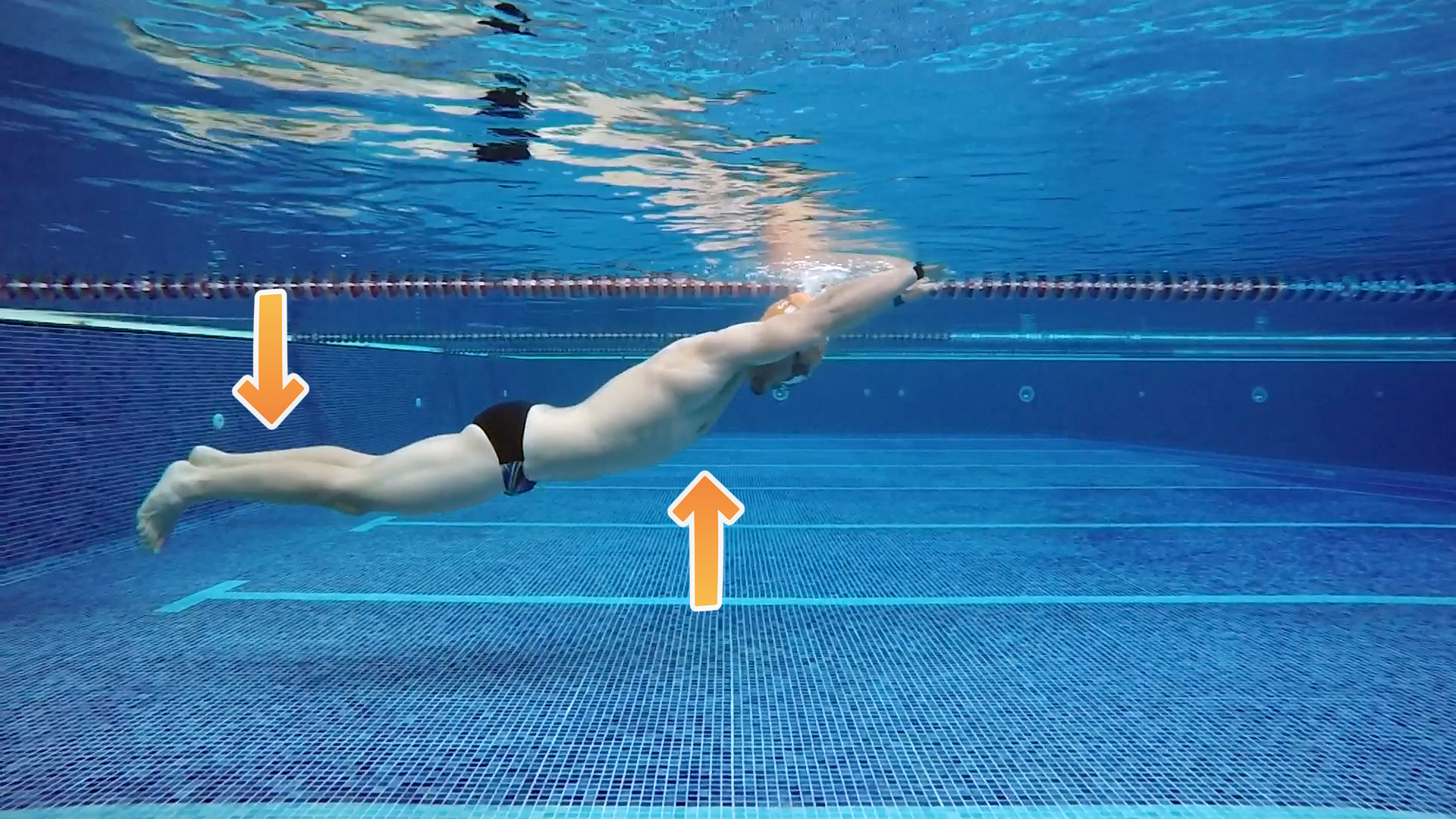
There are two forces responsible for your floaty chest and sinky legs.
{"{1}"} Buoyancy (an upwards force)
It supports or pushes up on your body and causes you to float
{"{2}"} Gravity (a downward force)
It pulls down on your body and causes you to sink
For you to float up on the surface of the water, the force of buoyancy must be greater than the force of gravity.
Where Gravity > is greater than > Buoyancy; You Sink 😠
Where Buoyancy > is greater than > Gravity; You Float 😊
The force of buoyancy is strongest around your chest. Because of your lungs, your chest has the lowest sp gr in your body. It is the least dense part of the body. This is where the force of buoyancy is strongest so we call the chest your center of buoyancy in the water ^1
The force of gravity is strongest around your legs. Your legs have a higher sp gr than water, so the force of gravity is strongest through your legs.
The way gravity acts on your body is a little weird. There isn't one specific spot gravity pulls down through. Unlike buoyancy, which always pushes up through your lungs, the force of gravity can shift. The exact location gravity pulls through will move based on your body position. It generally pulls down through the area of your hips. But it can move up towards your belly button or down toward your knees, depending on how you are positioned. We call the point that gravity pulls down through the "center of gravity" ^2
To float, the center of gravity and the center of buoyancy must align. Gravity must pull down in exactly the same line as buoyancy pushes up. With both forces pushing and pulling in the same place, you float level.
This is why you float in the tuck of the mushroom float. During the mushroom float test, your legs sit underneath your lungs. So your center of gravity and center of buoyancy line up, one on top of the other. As a result you bob up to the surface.
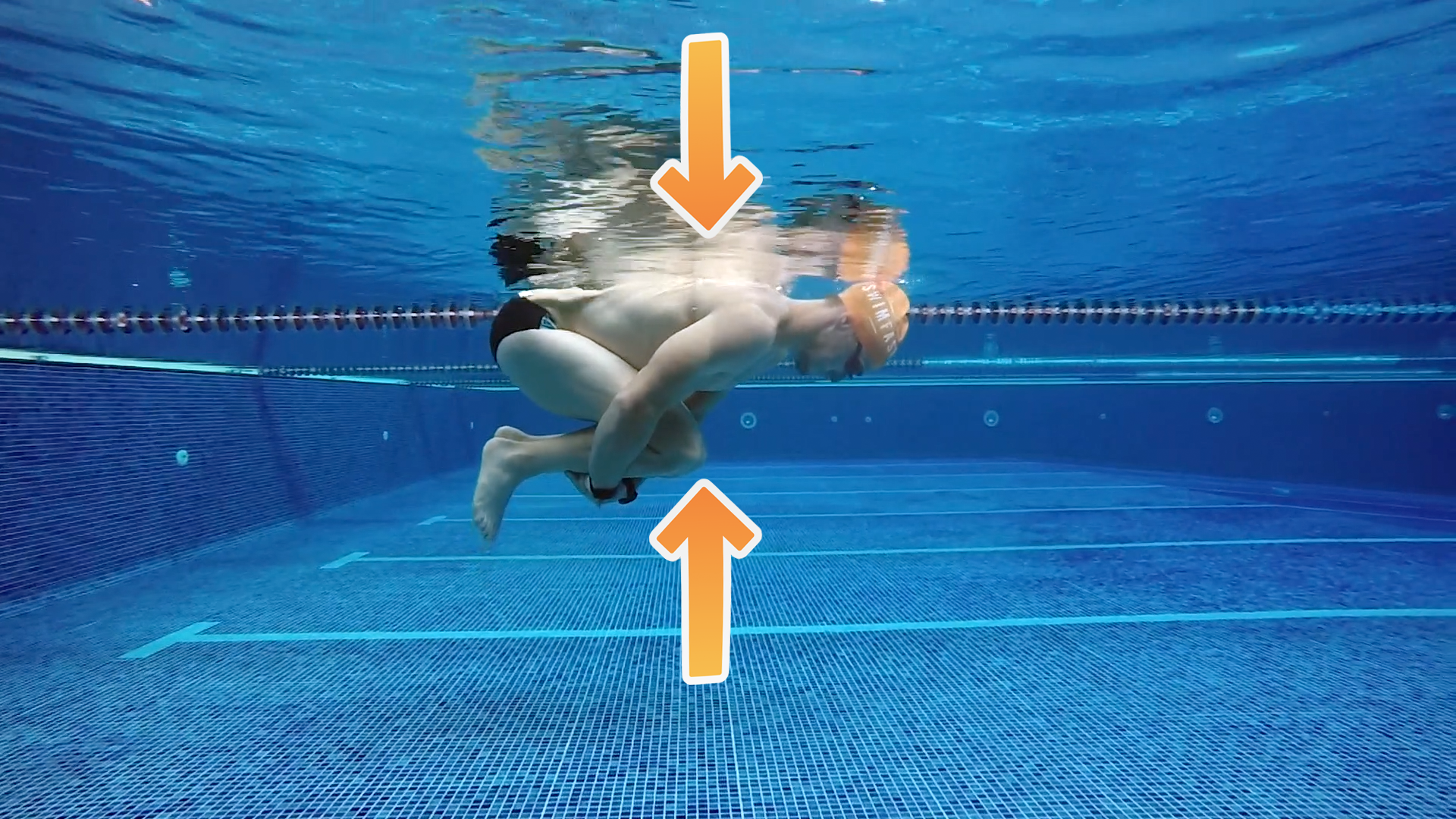
You don't swim freestyle tucked in the mushroom float ball though. And this is where the sinking leg problem is born.
As you stretch out your legs, the center of gravity begins to move down towards your feet. The further the center of gravity moves from the center of buoyancy, the faster your legs sink.
The Dead Man's Float
We now know the center of buoyancy always pushes through your chest. And we learned that the center of gravity pull shifts as your body position changes. The Dead man's float demonstrates this for us very nicely.
Here are the steps to do a dead man's float:
Phase 1:
- 1Begin with a mushroom float
- 2Taking a deep breath in and then hold your breath
- 3Lift your feet up off the floor and lower your head into the water
- 4Tuck your body into a ball, bring your knees up to your chest and hold your shins with your hands.
- 5Once you've floated up to the surface, release your legs and begin to extend them out behind you
- 6Notice how your legs sink as you open up your body
- 7When your legs have stopped sinking or you run out of breath, stand up
Phase 2:
Repeat the test again. The second time you do it, as you extend your legs out behind you, stretch your arms out in front of you at the same time.
What we see in Phase 1 of the dead man's float is that your legs sink no matter what. The legs have a higher sp gr than your chest and the water so they sink faster!
Nearly every adult's legs sink when doing the dead man's float.
Mine absolutely do!
As you stretch out the center of gravity begins to move down towards your feet. The further the center of gravity moves from the center of buoyancy, the faster your legs sink.
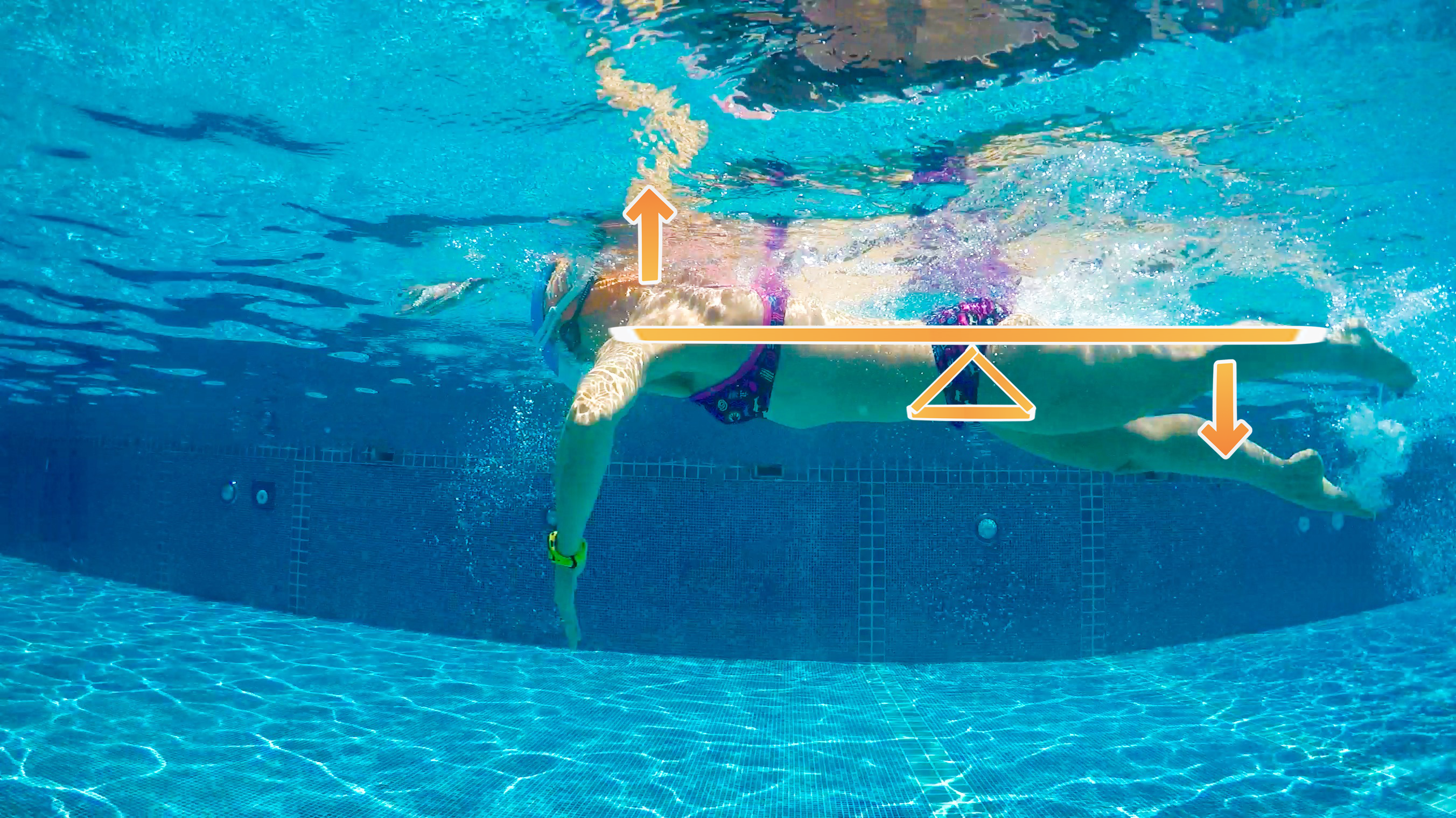
In all my years coaching, I've only had a handful of people that can float in this horizontal position (without kicking). The sp gr in their legs is lower than water and they are able to balance without moving. In most cases, these clients have been women and have had a higher body fat percentage at or around their hips. The extra fat decreases the sp gr in the legs which helps keep them level on the surface.